

A Dubai apartment kitchen leaves little room for appliance mistakes, while a villa kitchen offers more space, though that does not mean every 90 cm hob is the right fit. Factors such as open-plan cooking, heavy frying, cabinet depth, ducting, and the summer habit of keeping doors shut all play into that decision. A hood and hob that’s poorly matched to the space becomes noticeable every time the kitchen is used, while the right combination lets the kitchen simply work. Getting there comes down to understanding what the space actually needs, which is what this guide covers: hob size, hood width, suction power, kitchen layout, cooking style, installation requirements, and features worth paying for.
What Hob Size Is Best for a Small or Large Kitchen?
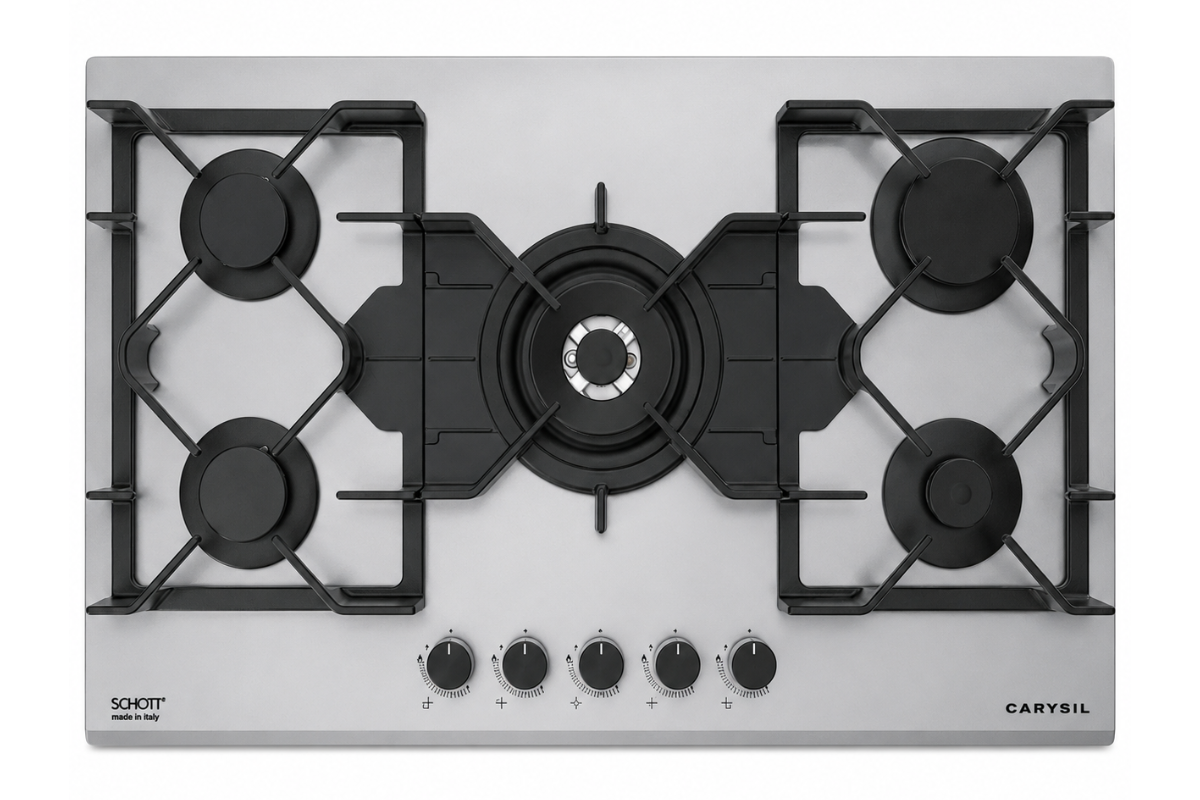
For a compact Dubai apartment kitchen, a 60 cm hob often makes more sense, leaving more usable worktop while still offering four cooking zones or burners. Carysil currently offers 60 cm four-zone gas options. A 90 cm hob earns its space in kitchens where several dishes are regularly cooked together, and Carysil’s range includes 90 cm models with 5 or even 6 burners, depending on the model.
Think about your actual cooking:
- One or two pans: 60 cm is usually enough.
- Several pans at once: A wider hob gives you more room.
- Large family meals: More burners can make a real difference.
- Wok or large cookware: Check burner spacing, not just the headline size.
- Compact worktop: Do not sacrifice preparation space for burners you rarely use.
One detail matters during installation: hob size and cutout size are not the same measurement. Carysil’s 90 cm Titanium Glass hob, for example, measures 895 × 524 mm, while its specified cutout is 875 × 504 mm. Telling a kitchen contractor to simply “make it 90 cm” is not enough; the actual installation specification needs to be provided instead.
What Size Hood Do You Need for a 60 cm or 90 cm Hob?
For a 60 cm hob, a 60 cm hood can work when the layout and cooking habits suit it. A wider hood can provide better coverage, especially when you regularly use larger pans or cook several dishes at once.
With a 90 cm hob, matching it with a 90 cm hood makes more sense. You do not want the outer burners sitting beyond the hood’s effective capture area.
A few things buyers often miss
- Hood width: Match it to the hob before looking at aesthetics.
- Hob layout: Burner position matters. A wide burner sitting near the edge needs adequate hood coverage.
- Cooking habits: Frequent frying creates more airborne grease and vapor.
- Kitchen layout: Open plan kitchens can benefit from broader capture.
- Installation height: Follow the hood and hob manufacturer’s specified clearance. Do not rely on a contractor’s usual measurement.
And here is the question worth asking: Should a cooker hood be wider than the hob?
It can be. In fact, a wider hood offers more capture area, though bigger is not automatically better, since the extraction system, installation, ducting, and actual cooking conditions all matter just as much.
How Much Suction Power Does a Kitchen Hood Need?
A hood rated at 1,000 m³/h sounds impressive. But that number means little if the kitchen, ducting, and cooking habits do not require it.
| A better starting point is the kitchen volume.
Kitchen length × width × height = kitchen volume. |
Teka recommends multiplying that volume by 12 as a practical benchmark for extraction capacity.
So, a 4 m × 3 m × 2.7 m kitchen has a volume of 32.4 m³. At 12 air changes per hour, that points to roughly 389 m³/h.
But Dubai kitchens are not all used the same way.
You may need more extraction when:
- The kitchen opens directly into the living room. Odors travel much farther.
- You fry regularly. Oil vapor creates a heavier extraction load.
- You grill or cook at high heat. More heat and airborne particles need capturing.
- You cook strong-smelling dishes. Nobody wants yesterday’s biryani lingering in the living room.
- The duct run is long or has several bends. Installation conditions can affect actual performance.
A hood that sounds like a small aircraft will eventually spend more time switched off than switched on, which is why Bosch considers models below 60 dB to be very quiet. Suction power on its own is not enough; it needs to be matched to the kitchen, cooking style, and installation to actually be useful.
Which Cooker Hood Type Is Best for Your Kitchen Layout?
The hood should follow the hob location. Not the other way around.
1. Wall-Mounted Hoods
When a hob sits against a wall, this is usually the straightforward option. A wall-mounted hood sits directly above the cooking area and can work well in both apartment and villa kitchens.
2. Built-In Hoods
These sit inside the cabinetry, suiting Dubai kitchens where the design calls for clean lines and fewer appliances on show. They also make sense when cabinet space has already been planned around the hood.
3. Island Hoods
Putting the hob on a kitchen island changes the equation. With no wall behind the cooking surface, the hood needs to be suspended from the ceiling, and coverage matters more since vapour can spread in every direction. This setup is particularly relevant in larger Dubai villas and open-plan kitchens.
4. Freestanding Hoods
These offer more flexibility when the kitchen layout does not call for full cabinet integration. Carysil’s UAE range includes built-in, island, and freestanding hood options, allowing the choice to follow the kitchen rather than forcing the kitchen around one hood design.
Which Hob Type Is Better for Your Cooking Style?
Kitchen size tells you what will fit. Your cooking style tells you what you will actually use.
| Consideration | Gas Hob | Induction Hob |
| Heat control | Direct flame gives familiar control | Precise electronic control |
| High heat cooking | Excellent for wok cooking and searing | Very good, depending on the model |
| Heating speed | Fast | Usually very fast |
| Cleaning | More parts and raised supports | Flat surface is easier to wipe |
| Cookware | Works with most cookware | Requires compatible magnetic cookware |
| Power source | Gas connection required | Electrical connection required |
| Power cuts | Can remain usable if ignition and gas supply allow | Requires electricity |
| Best suited to | Flame-based cooking and traditional cooking styles | Fast cooking and easy cleanup |
Carysil offers several gas hob configurations, including 4- and 5-burner models in its UAE range. Choosing induction without checking the electrical supply first can be a costly oversight, as a high-powered hob needs the right electrical provision to function properly.
Which Hood and Hob Features Are Actually Worth Paying For?
Some features change your daily cooking. Others look impressive until you realise you never use them.
For the hood, pay attention to:
- Variable speed control: Useful when a quick sauté needs less extraction than heavy frying.
- Filter saturation indicator: You do not have to guess when the filter needs attention.
- Auto shut off: Handy when you finish cooking and forget the hood is still running.
- Washable filters: Less hassle when grease builds up.
- Useful lighting: More important than decorative lighting when you are actually cooking.
- Noise level: A powerful hood is less useful if everyone switches it off because it is too loud.
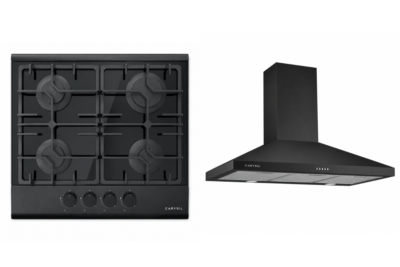
Carysil’s range includes models with features such as filter saturation indicators, timers, multiple speeds, LED lighting and washable aluminium filters. Its Frame 180 B IS island model, for example, lists 5 speeds, 1,200 m³/h extraction and a 48 dB sound level.
For the hob, look for:
- Flame Failure Device: Important on gas models. It cuts the gas supply if the flame goes out.
- Automatic ignition: Saves you from reaching for a lighter.
- Cast iron supports: Useful for heavier cookware.
- Wok burner: Worth considering if high heat cooking is part of your routine.
- Timers and safety controls: Useful for busy households.
Carysil’s 90 cm Titanium Glass model includes automatic ignition and a Flame Failure Device, while another 90 cm model includes a triple wok burner.
Conclusion
Choosing a hood and hob is not really about filling two appliance slots. It starts with cooking style, then works around the space available, whether that means a 60 cm hob for an apartment or a 90 cm setup for a busy family kitchen. Matching the hood to the hob, sizing the extraction properly, and checking the installation drawings before the cabinets are cut is what makes the kitchen work as well as it looks, and Carysil can help settle those details beforehand.
Frequently Asked Questions
1. Should the hood be wider than the hob?
It can be. A wider hood can improve capture, especially with heavy cooking or larger hobs.
2. How high should a cooker hood be above a hob?
It depends on the hood and hob type. Always follow the manufacturer’s specified clearance.
3. Is a 60 cm hob enough for a family?
For many households, yes. Choose 90 cm when you regularly cook several dishes together.
4. Is a chimney hood better than a built-in hood?
Neither is automatically better. The right choice depends on your kitchen layout, cabinetry, and extraction setup.
5. What is the best hood for an open-plan kitchen?
Look for sufficient extraction capacity, suitable coverage, and low operating noise. Island kitchens may also need an island-specific hood.